

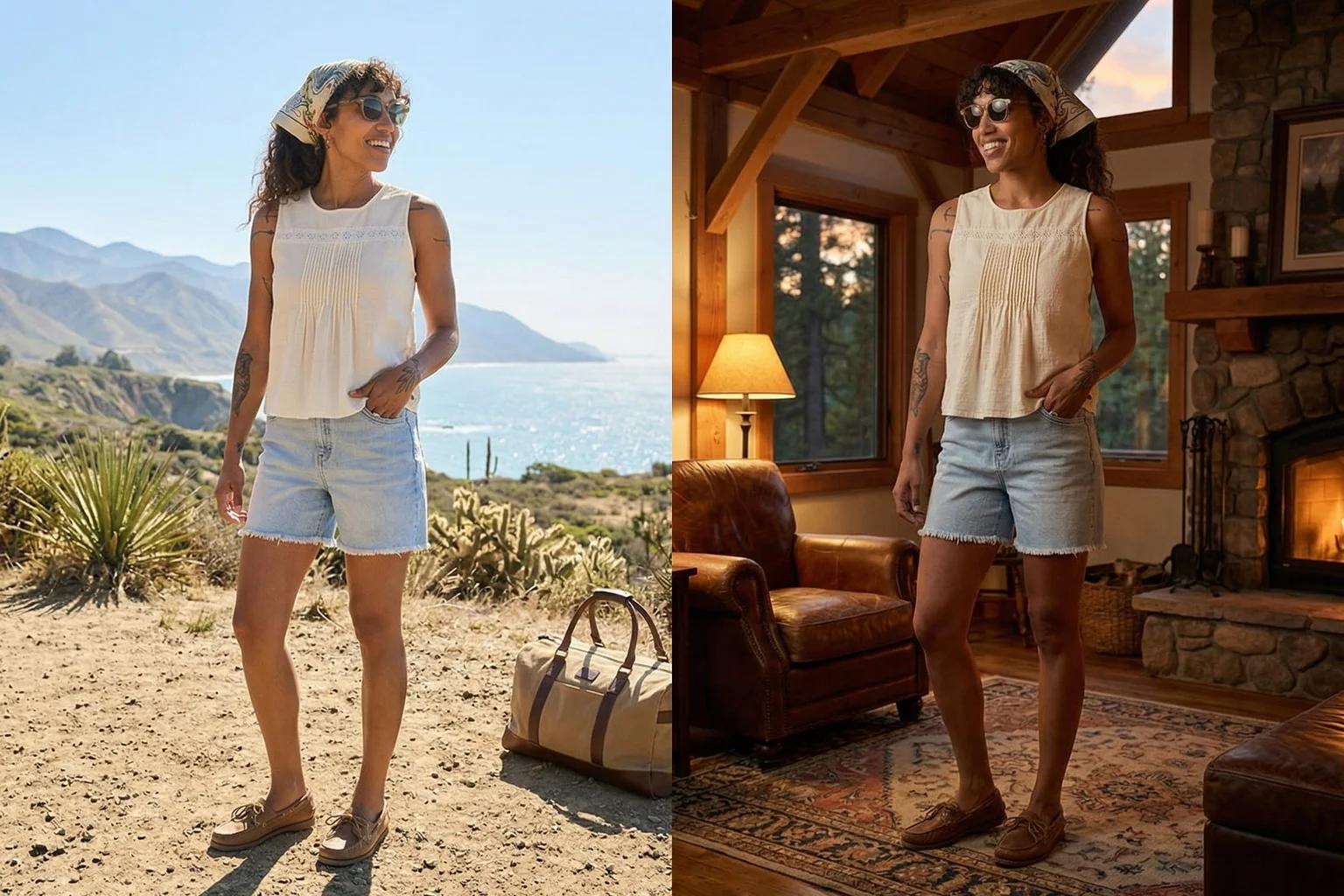
Why background flexibility matters for Toad&Co
Toad&Co sells sustainable apparel with a strong outdoor, community-led identity. Its public story emphasizes doing good since 1996, using more sustainable materials, supporting nonprofit work, and making the outdoors more accessible. That means the brand's imagery often has to carry more than the garment. It also needs to carry place: trail, town, travel, store, shoulder season, sunshine, and lived-in movement.
For brands like this, environment does a lot of merchandising work. A background can make the same dress feel like weekend travel, urban summer, or campground layering. The problem is that every environment change traditionally implies another location plan, more scheduling, and additional production overhead. That slows down the team's ability to localize a product story for different channels and markets.
The background-swaps-at-scale use case solves exactly that problem. In this illustrative scenario, Toad&Co would use UNSTILL to extend a single strong product story into multiple contextual settings while preserving the garment, pose logic, and brand tone. That would let the team create more channel-appropriate and geography-aware creative without reshooting every look.
The operational bottleneck
Outdoor and lifestyle brands often depend on scenes that feel believable, relaxed, and specific. A product might be launched against one background, but the business still needs other versions of that story. Retail teams want imagery that feels closer to storefront shoppers. CRM may need a softer, more seasonal backdrop. Paid social may require environment-specific hooks. Regional campaigns may work better when the setting feels connected to local weather, terrain, or cultural cues.
Those needs can multiply quickly. Even when the original shoot is good, the team ends up either overusing one environment until it feels stale or spending too much to rebuild the same product story somewhere else. That is a poor trade-off, especially when the product itself has not changed.
In a Toad&Co-style operation, background swaps would be less about novelty and more about relevance. UNSTILL would let the team hold onto the garment presentation and the easygoing brand energy while changing the scene to meet the moment.
How UNSTILL would be used
The workflow would begin with hero imagery that already captures Toad&Co's core visual characteristics: natural posture, approachable styling, an outdoors-adjacent sensibility, and a relaxed emotional tone. From there, UNSTILL could generate environment-specific extensions around that approved product presentation.
One set of outputs could support regional marketing. A warm-weather market may need a brighter, lighter context than a colder one. Another set could support campaign localization around themes like travel, weekend adventure, or town-to-trail versatility. A third set could help distinguish retail and ecommerce messaging without forcing the creative team to build separate shoot plans for each.
This matters because apparel like Toad&Co's often sells through versatility. The same product needs to look comfortable in more than one context. Background adaptability gives the team a more efficient way to tell that story.
The merchandising upside
Changing backgrounds at scale would help Toad&Co present garments as multi-context products rather than one-scene products. A shopper could see how the same item travels across different moments of use, which strengthens the brand's promise of easy, functional, sustainable style.
It would also support campaign freshness. If the team can generate new environmental contexts around the same hero product assets, promotional storytelling stays active longer. The catalog feels renewed even when the product mix is stable. That is particularly useful for brands with long-wearing staples and sustainability-led assortments, where extending the life of a style is a commercial virtue rather than a liability.
Operationally, it would make it easier to support multiple teams from one asset base. Ecommerce, growth, retail, and CRM could all work from a shared product story while still receiving context-specific creative. That reduces fragmentation and keeps the brand's visual voice more coherent.
A practical rollout plan
The most effective pilot would likely focus on a product family that already performs across multiple use cases, such as easy dresses, versatile tops, or lightweight layers. The team could choose one approved hero set, define the environmental contexts that matter most commercially, and use UNSTILL to generate those variations under controlled creative rules.
Those rules would be important. Toad&Co's brand world is rooted in authenticity, so the generated scenes would need to stay natural and restrained. The goal would not be dramatic fantasy settings. It would be believable contextual shifts that make the garment more useful to more audiences.
The team could then measure asset reuse across channels, the speed of creative adaptation for regional or seasonal asks, and the engagement difference between context-matched assets and generic reused imagery. If the results showed higher utility and lower production drag, the workflow could expand into a standing localization function.
Where the cost savings show up
The headline savings would come from avoiding repeat location production for every context shift. But the deeper savings would come from creative simplification. Once the team knows a product story can travel into multiple backgrounds without a new shoot, campaign planning becomes easier. Internal requests that used to feel expensive become manageable.
There is also a timing advantage. Many localization needs emerge late. A market request comes in after the original shoot. A retailer asks for a different visual mood. A promotional window changes. UNSTILL would let Toad&Co answer those late-arriving needs without blowing up the calendar.
That agility matters because commerce rarely operates on a perfect production rhythm. The brands that handle shifting asks best are the ones with the most flexible asset systems.
The illustrative outcome
In this scenario, the first result would be more mileage from strong hero imagery. Toad&Co could keep using what already works while adapting it for different audience contexts.
The second result would be faster regional and channel-specific rollout. Instead of forcing every localization request into a new shoot conversation, the team could handle many of those asks inside a controlled generation workflow.
The third result would be better storytelling around product versatility. A garment that looks credible in multiple environments becomes easier to justify, easier to gift, and easier to imagine in real life.
Why this use case is right for the brand
Toad&Co is not trying to win with studio neutrality alone. Its products live in relation to place and purpose. That makes background flexibility unusually valuable. UNSTILL fits because it would help the brand expand environmental relevance without sacrificing efficiency or visual coherence.
This is what smart background swapping looks like for a sustainability-led apparel company. It is not about gimmick scenes. It is about giving one strong product story enough contextual range to support a more complex business. When the same item can speak convincingly to different moments and audiences, the entire marketing system becomes more efficient.
For Toad&Co, that means more localization, less reshoot pressure, and a better return on every good piece of creative the team already has.