

Why licensing complexity matters more in accessories
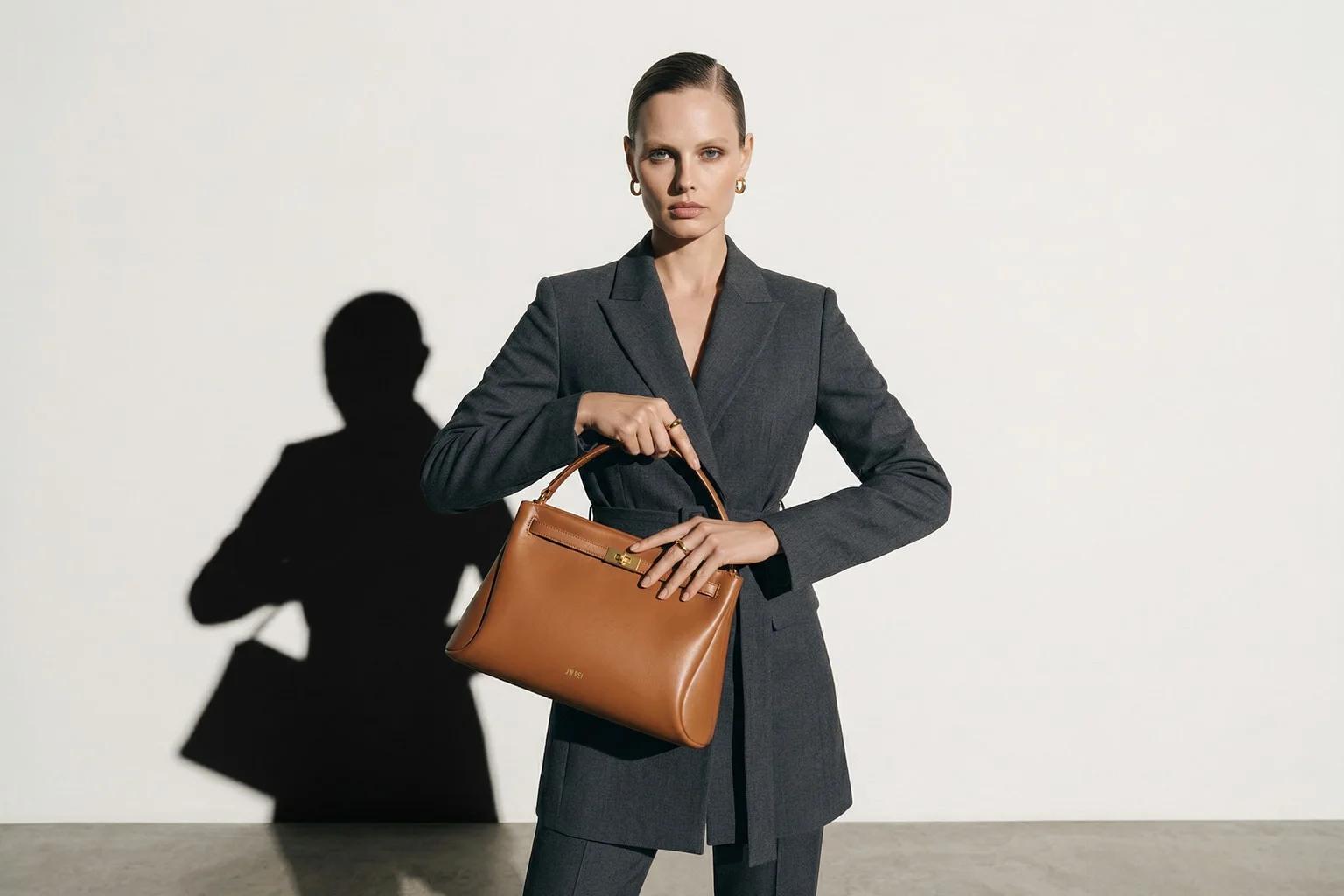
JW PEI sits in a category where product storytelling has to travel. The brand's public storefront emphasizes handbags, shoes, clothing, and accessories, with a strong focus on vegan-leather bags and polished silhouettes that can move across markets and customer segments. That type of assortment naturally creates a large demand for reusable campaign imagery. A hero bag is rarely only a PDP asset. It becomes homepage creative, paid media, editorial support, social content, email, gift guides, marketplace content, and often a long-tail best seller that needs to keep appearing well beyond its launch window.
The problem is that conventional model-based campaigns do not always scale cleanly into that level of reuse. As teams expand creative across regions, placements, and timelines, licensing details start to matter. Can the image be used globally? Can it live for more than one season? Does reuse in a paid campaign require additional approvals? Does the same asset carry different constraints in email, wholesale support, or an international launch? Those questions create friction even when the original shoot was successful.
For an accessories brand with fast-moving hero products, that friction becomes expensive. It slows the creative team, complicates legal and operations, and makes it harder to extend the life of winning imagery. That is why the lower-licensing-fees use case is strategically relevant for JW PEI.
The hidden cost is not just the fee
When people talk about licensing cost, they often mean the direct line item attached to model usage. But the heavier burden is usually indirect. Teams hesitate to reuse high-performing creative because they are unsure how far the rights extend. Growth marketers request alternate assets rather than risk overusing the best one. International teams create parallel content because the original images were not cleared the way they need them. Over time, the brand pays not only in fees but in duplication, delay, and underused creative.
For JW PEI, that duplication is particularly wasteful because the product categories lend themselves to repetition. A strong handbag image can support many placements. A polished shoulder bag or top-handle silhouette can move from launch email to gifting edit to retargeting creative without losing relevance. The brand does not need to recreate desire from scratch every time. It needs the legal and operational freedom to keep deploying what already works.
In this illustrative scenario, UNSTILL would give JW PEI that freedom. The goal would not be to eliminate live photography altogether. It would be to reduce the share of the asset library constrained by recurring model-usage considerations and create more campaign-ready imagery that the team can extend confidently.
How UNSTILL would fit a JW PEI-style content operation
The first application would be launch support for hero accessories. Once the brand identifies the handbags, shoes, or coordinated looks likely to carry a collection, UNSTILL could generate campaign extensions that preserve the premium, modern tone of the original concept while remaining easier to reuse across channels and markets. That means the creative team could hold onto the visual idea that is working without turning every expansion request into a licensing review.
The second application would be lifecycle reuse. Accessories often outlive the exact moment they launched in. A bag may reappear in gift guides, bestseller edits, seasonal merchandising, and retention campaigns months after its debut. With UNSTILL, the team could create additional placements and variations around that product without worrying that an extended usage window will trigger new friction.
The third application would be market adaptation. A brand serving multiple geographies frequently needs alternate imagery for different calendars, climate cues, and media plans. UNSTILL would let JW PEI adapt a successful product story for those needs while keeping the product at the center and reducing the dependency on a single finite shoot.
Why this use case is about growth, not only savings
Cost reduction is a useful starting point, but it undersells the opportunity. The real upside is that licensing-light creative can move faster through the organization. When marketers trust that an asset library is flexible, they use it more aggressively. That improves campaign continuity and makes the content system more efficient.
For JW PEI, that could mean faster international rollout, more consistent paid social reuse, cleaner handoff between launch and retention teams, and longer value extraction from a winning product story. Instead of asking whether an image can be used again, the team can focus on where it should be used next.
This is especially important in accessories because product desirability often compounds through repetition. The same bag becomes more desirable as the customer sees it across more contexts: styled, editorialized, gifted, discounted, or simply reaffirmed as a bestseller. If rights constraints suppress that repetition, the brand leaves commercial value on the table.
A realistic rollout path
The most practical pilot would likely focus on one core accessories line and one campaign window. JW PEI could select a small set of priority bags, map the expected downstream placements, and identify where model-usage constraints usually create hesitation. That would provide a baseline for evaluating whether UNSTILL-generated campaign extensions reduce friction.
The test would not need to replace the flagship shoot. In fact, it would be stronger if it complemented it. Live photography could establish the initial direction and product authority. UNSTILL could then expand the asset set into high-frequency uses such as paid variations, email modules, international campaign support, and longer-tail product storytelling.
Metrics would likely include asset reuse rate, turnaround time for campaign extensions, number of placements supported from a single hero product story, and reduced dependence on new production for lifecycle creative. Those are the measures that reveal whether the content system is becoming more flexible.
What the output could look like
In this scenario, JW PEI would build a reusable visual library around hero bags rather than around isolated image files. Each product story could include launch visuals, alternate crops, market-specific treatments, and retention-ready variants that all preserve the same premium brand tone. The bag remains the hero, the styling remains elevated, and the business gains more freedom in how long and how widely those assets can travel.
That would be particularly helpful for bestselling silhouettes. Instead of allowing a successful bag story to fade because the original campaign assets are cumbersome to reuse, the team could extend it into new moments with much less friction. A giftable shoulder bag, for example, could move from full-price launch to holiday support to post-holiday remarketing with creative continuity intact.
It would also help reduce campaign sprawl. When content teams are constrained, they often build disconnected alternatives for each new need. A more flexible generation layer would keep those alternatives inside one coherent visual world.
The illustrative business impact
The first impact would be simpler rights management around campaign expansion. That does not only lower direct cost. It lowers hesitation. Teams can do more with assets they trust.
The second impact would be more mileage from every strong product story. A high-performing accessory could remain visually active across more channels and more months without triggering a fresh production loop each time.
The third impact would be a better growth engine. When paid, CRM, and ecommerce teams can all access flexible, premium-feeling creative, successful campaigns compound instead of restarting. That is a material advantage for a product-led brand.
Why UNSTILL fits JW PEI's catalog reality
JW PEI needs imagery that looks elevated, modern, and marketable at scale. It also needs the freedom to keep reusing that imagery as bags move from newness to bestseller to long-tail catalog hero. UNSTILL fits that reality because it can be used as an asset-rights simplifier and a campaign-extension layer at the same time.
This illustrative case study shows why the lower-licensing-fees use case is not a back-office optimization. For a brand like JW PEI, it is a growth enabler. Fewer constraints mean more reuse. More reuse means stronger continuity. Stronger continuity means more value from the same products, the same ideas, and the same demand signals.
That is the kind of efficiency that compounds.