

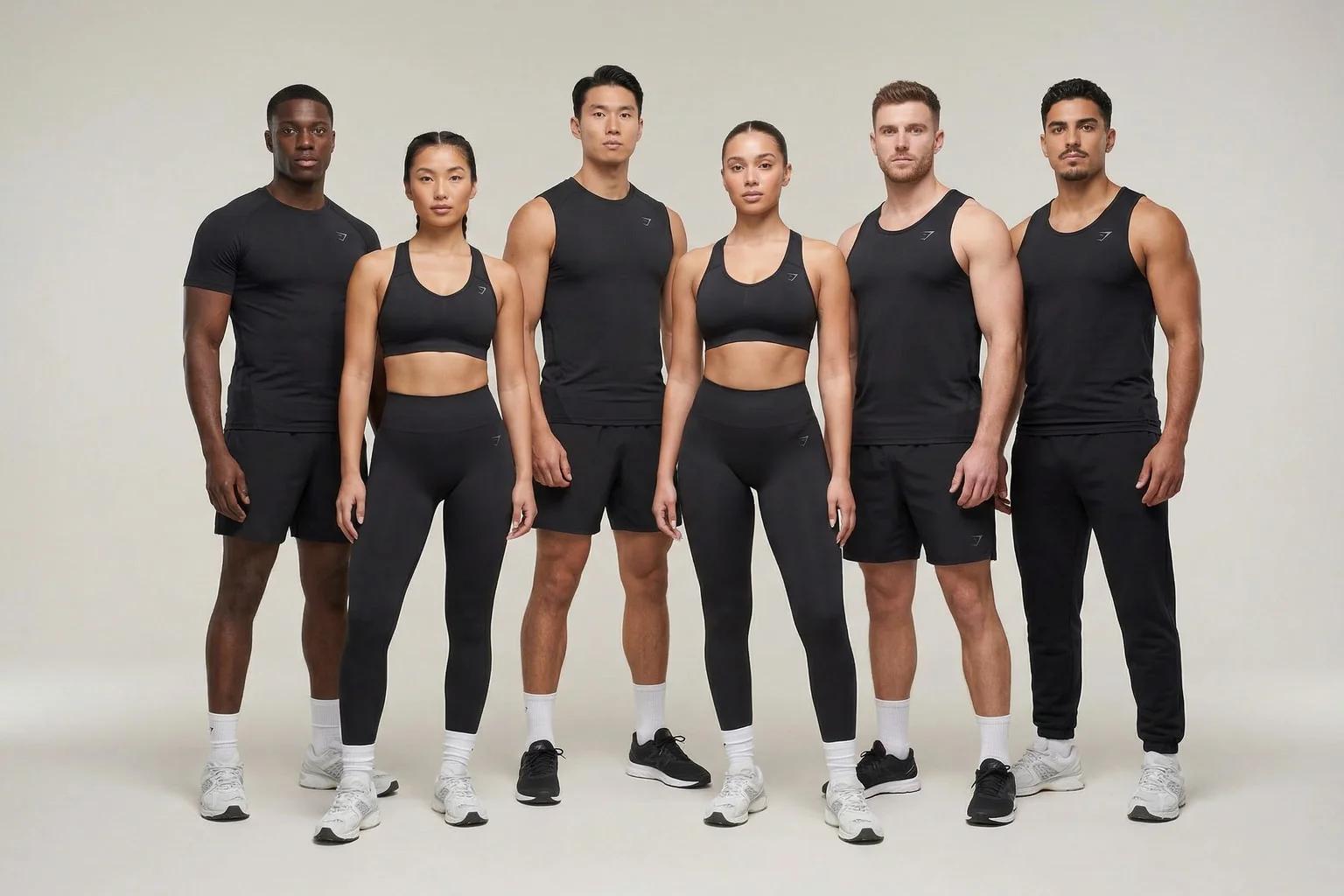
The catalog problem brands reach when they scale
Gymshark has the kind of catalog that exposes every inconsistency. The brand serves a global training community, carries a broad range of women's and men's products, launches often, and operates in an ecosystem where product discovery happens across app, web, social, creator channels, and performance media. At that scale, product imagery is never produced in one clean, synchronized batch. It accumulates over time.
That accumulation creates a familiar issue for high-growth commerce teams. Some products have newer, cleaner imagery. Others still rely on older PDP assets that no longer reflect the current standard. A best seller from one category may sit beside a recent launch from another, and the customer sees the mismatch immediately. Even if every image is technically acceptable, the catalog can still feel uneven. Older assets start to drag on the perceived quality of the shopping experience.
For a performance-led brand like Gymshark, that matters. Customers are comparing fabric, fit, compression, silhouette, and lifestyle cues quickly. When the imagery standard shifts from page to page, the product signal gets weaker. The brand ends up carrying avoidable friction in the very place where conversion should feel easiest.
Why revamping the catalog is so hard in practice
A complete reshoot sounds good until the team prices it out. Large catalogs create a nasty ratio between strategic importance and operational feasibility. Everyone agrees the old imagery should be refreshed, but there are too many active SKUs, too many categories, and too many launch obligations already competing for production time. As a result, legacy content lingers far longer than anyone wants.
The problem is not limited to old products either. New imagery can create its own issue. If a launch receives high-quality, modern assets but adjacent products do not, the catalog begins to split into visual tiers. One part of the site communicates the current brand standard while another reveals its history. That split can weaken cross-sell, comparison behavior, and trust in the assortment.
In this illustrative scenario, Gymshark would use UNSTILL as a catalog harmonization layer. The goal would not be to erase the role of live production. It would be to help the team close the gap between top-tier launch imagery and the long tail of products that still need to look current.
Where UNSTILL would deliver the most value
The first high-value application would be aging hero PDPs. Gymshark almost certainly has products that still attract meaningful traffic but no longer reflect the current visual standard. Those are the fastest wins because a better asset set would influence both shopper confidence and the overall quality of the category page around it.
The second application would be category normalization. When leggings, tops, outerwear, and accessories have been photographed across different windows, the category experience can feel inconsistent even if individual pages are strong. UNSTILL could help bring those categories closer together in lighting, framing, model energy, and product emphasis.
The third application would be launch extension. A successful collection or hero visual treatment often sets a standard the rest of the catalog cannot immediately match. UNSTILL would allow the team to extend elements of that winning treatment into adjacent products, helping the broader assortment feel more current without scheduling another full production loop.
The product-storytelling advantage
Activewear shoppers make fast visual judgments. They want to understand how compression looks in motion, how seams sit on the body, whether a layer reads as performance-first or lifestyle-leaning, and how pieces fit into a broader training wardrobe. That makes imagery especially powerful in this category. If some pages deliver modern, clear, high-trust visuals while others feel dated, the shopper's confidence fluctuates with the asset quality instead of staying anchored in the brand.
In the Gymshark scenario, UNSTILL would help stabilize that experience. The team could bring older or lower-priority products into closer visual alignment with current category leaders. That would improve the browse-to-PDP path because comparison becomes easier when the visual language is shared.
It would also improve category storytelling. A training collection should feel like a system. Matching tops, bottoms, layers, and accessories should look as if they belong together even when they were not all produced at the same time. Catalog refresh work creates that system-level clarity.
How the rollout could be structured
The smartest pilot would begin with one or two high-volume categories and a set of products already known to have mixed-vintage assets. The team could define what a current-standard PDP looks like, then identify where legacy pages fall short. That would create a simple priority stack: top traffic, high comparison behavior, and products likely to benefit from updated styling or cleaner visual framing.
UNSTILL could then be used to generate refreshed hero and supporting imagery inside that category standard. The creative team would not need to solve every edge case at once. It could focus on a repeatable set of shots that make the products easier to evaluate and make the category feel newer as a whole.
From there, the team could measure a combination of signals: image engagement, category-to-PDP click quality, PDP conversion on refreshed products versus controls, and overall visual consistency across the category. If those results were strong, Gymshark could expand the workflow into adjacent categories and eventually turn refresh work into a standing catalog-maintenance function.
Why this reduces more than production cost
Catalog refresh is often framed as a budget issue, but the real burden is prioritization. Large brands delay visual updates because production resources are always needed somewhere else. UNSTILL changes that equation by making refresh work less dependent on finding extra shoot capacity. That gives the ecommerce team a practical route to improving the catalog continuously rather than waiting for a perfect moment that never arrives.
It also reduces creative debt. Every legacy product that remains visually outdated adds a small amount of drag to the site. Enough of those pages and the drag becomes systemic. A scalable refresh layer helps the brand stop accumulating that debt and start paying it down.
For Gymshark, that matters because the catalog is not just a library of products. It is a performance environment. If the imagery is uneven, it affects how effectively the brand can convert interest into action.
The illustrative business result
In this scenario, the first outcome would be a more modern-looking shopping journey across high-value categories. Customers would move between products with fewer abrupt shifts in image quality, composition, and overall brand feel.
The second outcome would be better leverage from strong launch standards. Instead of confining the best visuals to the newest products, Gymshark could spread that standard further across the catalog, making the site feel newer without needing to recreate every page from scratch.
The third outcome would be stronger performance from the long tail. Older products often continue to contribute meaningful revenue. Refreshing their presentation would help the brand capture more of that value rather than allowing those pages to underperform simply because their content has aged.
Why this is a strong UNSTILL use case
Gymshark's challenge is not a lack of content ambition. It is the practical difficulty of keeping an enormous catalog visually current while the business continues to launch, iterate, and scale globally. UNSTILL fits because it offers a way to make catalog quality more maintainable.
This is what revamp-your-catalog should mean for a brand at scale. Not a one-time makeover. Not an expensive reset. A repeatable system for keeping the site aligned with the brand's present-day standard, even when products entered the catalog months or years apart.
In that sense, UNSTILL becomes less of a campaign tool and more of a merchandising infrastructure layer. For a fast-moving commerce brand, that is exactly where the value compounds.