Most small fashion brands do not have a photography problem. They have an allocation problem. They are spending money, time, and attention in the wrong places. They may be paying for a polished shoot but getting weak source images. They may be chasing social content while their product pages remain thin. They may be reshooting too often because the original assets were not created with reuse in mind.
Budget photography is often described as a compromise. It does not have to be. A disciplined budget can still produce strong ecommerce assets if the team understands what actually affects image quality and what only creates the appearance of sophistication.
The goal is not to make cheap looking photography. The goal is to build a lean image system that protects trust, supports conversion, and leaves room for growth.
Spend first on garment readiness
If your budget is tight, one of the highest return investments is not a camera upgrade or a more complex set. It is garment preparation. Steaming, lint removal, proper pinning, careful arrangement, and a consistent prep checklist improve the final result more than many brands expect.
This is especially true in apparel because the garment itself is the product. Small flaws in the sample read as flaws in the brand. A twisted placket, a folded hem, or a wrinkled sleeve quietly tells the customer that detail is not under control. No lens can fix that logic.
If you have to choose between spending more on capture hardware or spending more time and care on prep, prep usually wins first.
Spend on simple, stable lighting
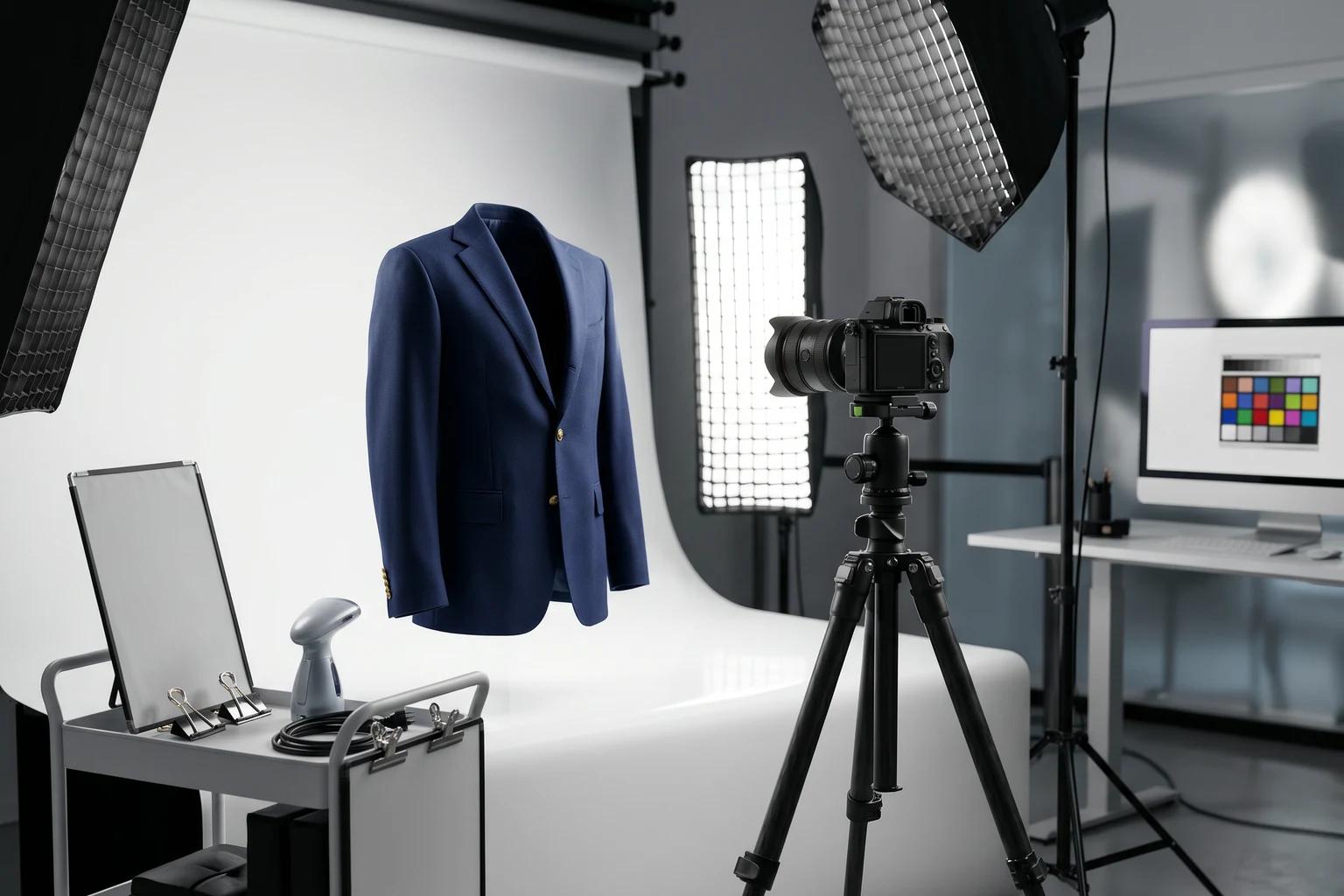
Lighting matters. Complexity does not always matter. For most ecommerce apparel work, stable and flattering light is enough. You do not need an elaborate mood setup to create a useful source file. In fact, a more elaborate setup can make the image less reusable.
A simple lighting approach that gives even exposure, good color, and clear garment edges will go much further than a more theatrical approach that creates dramatic contrast. Honest light helps the customer shop. It also helps later editing, repurposing, and transformation.
This is one reason budget brands should avoid trying to imitate luxury campaign lighting in every image. The commercial job of the file is different.
Skip visual tricks that reduce reuse
Many teams under budget feel pressure to make every shot look expensive, so they add props, textured surfaces, unusual angles, or heavy crops. These choices can make a single image feel more styled, but they often reduce the long term value of the asset. The file becomes harder to compare across the catalog, harder to crop for other channels, and harder to use in other creative workflows.
If your budget is limited, each image needs to stay useful for as long as possible. That means flexibility is worth more than momentary drama.
This does not mean everything should look plain. It means the source asset should remain clean enough to travel.
Spend where the customer sees the difference
Not every image deserves the same level of production. The product detail page hero for a best seller deserves more attention than a deep inventory variant that gets little traffic. A launch product needs stronger support than a low volume back stock item. The same goes for categories where fit and movement matter more.
Budget discipline often comes down to prioritization. Put the highest quality attention where the business has the most to gain. Use more efficient workflows for the rest. This can mean keeping certain categories on mannequin or flat lay sources while selectively investing more in on body or channel specific assets for priority pieces.
That is not cutting corners. That is matching effort to upside.
[Visual suggestion: side-by-side comparison of a budget-conscious apparel setup that preserves garment clarity versus a styled setup that wastes spend without helping readability]
Use source images that can do more than one job
One of the most expensive habits in fashion ecommerce is creating one time assets. A product gets photographed for a page, then the team realizes it also needs launch email, social, paid media, and marketplace variants. Suddenly the brand is reshooting or struggling to adapt files that were never designed for reuse.
The smarter move is to create source images with future jobs in mind. A clean flat lay, mannequin, or on model source can support much more than one single placement. It can be cropped for different channels. It can anchor consistency across a collection. It can also support workflows that turn a single garment image into fresh model or background directions later.
This is one of the most reliable ways to stretch a budget without lowering standards.
Keep the product page sacred
Brands sometimes overspend on top of funnel visuals while the product detail page remains undernourished. That usually happens because campaign content feels more glamorous internally. But the PDP is where the sale is often won or lost. If the customer cannot understand the product there, stronger social content only gets them to a weaker page faster.
A tight budget should protect the basics first. Clear product imagery, consistent framing, honest lighting, and reliable fit communication matter more than a large volume of flashy assets. Once the site has that foundation, additional creative begins to compound instead of compensate. How to build a fashion PDP image sequence that helps shoppers decide faster is a useful reference when you need to decide what deserves budget first.
Reduce reshoots by reviewing smarter
Reshoots are one of the fastest ways to destroy a photography budget. They cost time, samples, coordination, and attention. Many reshoots happen not because the team lacked resources, but because it lacked a better approval process at the right moment.
Build a simple review step into the shoot itself. Check the garment prep. Check the crop. Check lighting and color trust. Compare the image against the category standard. Make sure the product reads clearly at both full size and thumbnail scale. That small pause is usually much cheaper than discovering the problem after the day is over.
Use fewer images with clearer purpose
A budget brand often assumes the answer is more images because it is trying to cover more use cases. Sometimes the answer is the opposite. Fewer images, chosen and reused more intelligently, often create a better system. One solid source image can support several assets if it is captured and organized properly. Ten weak images rarely solve ten problems.
This idea becomes even more valuable when paired with a workflow that can turn existing product imagery into additional on body or channel specific content later. In that case, the original file does not need to be the final asset for every channel. It needs to be a strong foundation.
Know where AI can improve budget efficiency
Budget fashion photography does not only mean shooting cheaper. It can also mean getting more output from the photography you have already paid for. This is where AI assisted workflows can become very practical. A clean flat lay or mannequin photo can support additional model imagery. A strong on model image can be refreshed with different model direction. A stable product image can be adapted for cleaner social or launch use.
The important point is that the source still needs to be good. AI does not rescue sloppy input reliably. But when the source is solid, it can extend the life and range of existing photo investments in a way that matters to small brands.
If the main challenge is improving the source images themselves, start with the UNSTILL prep guide. If the challenge is getting more value from one approved image, the review and export guide shows how to think about downstream use more strategically.
Build a ladder instead of a wish list
One useful mindset shift is to stop building a photography wish list and start building an asset ladder. At the base, you need clear, reusable source images. Next, you need dependable product page assets. After that, you can create higher value variations for launch, social, and campaign moments. If a product proves important enough, then it can justify deeper investment.
This ladder keeps budget from being swallowed by ideas that have not yet earned it. It also helps the team understand why some products get more visual support than others.
A simple spending order for small brands
If you want a practical order of operations, this is a strong place to start.
- Garment prep and consistency.
- Simple, reliable lighting.
- Clear framing and background discipline.
- Organized file naming and review.
- Additional asset creation for priority products only.
This order may not feel glamorous, but it tends to create the best long term results.
The practical conclusion
Ecommerce fashion photography on a budget is not about finding the cheapest possible setup. It is about protecting the parts of the process that create trust and usefulness, then refusing to overspend on choices that add little lasting value. When brands do that, they stop wasting money on visual theater and start building image systems that are stable, reusable, and commercially effective.
That is the right ambition for a tight budget. Not pretending to be a big brand for one day, but creating a content workflow that gets smarter and more valuable every time the next product needs to launch. If you need more output without adding another shoot day, use Unstill to extend the strongest source images you already have instead of paying to recreate them.